
How to Switch Banks Without the Hassle
Like eating better or finally sticking with a workout routine, changing banks is one of those things many people know they should do long before they actually do it. The benefits are easy to see. The follow-through can be a bit harder.
Fees may have gone up, or personal service may have gotten harder to find. Or maybe you just don’t recognize the name on the front door anymore. Even then, switching can feel like a big undertaking. There’s always the worry that a paycheck might go to the wrong account or an automatic payment could get missed.
Those concerns are reasonable. But with a checklist and a little overlap between accounts, you can handle most of the setup in an afternoon and give your deposits and payments time to move safely.
Why People Stay Put Longer Than They Should
Plenty of people across Greater New Orleans area keep bank accounts that no longer serve them well, mainly because moving everything sounds like more trouble than it is worth.
The concern often comes down to worry about recurring transactions. A paycheck or Social Security deposit may be coming in. Utilities, insurance premiums, loan payments and subscriptions may be going out. Payment apps and transfers may also be linked to the account.
That’s why the order and organization matter. Let’s walk through the details.
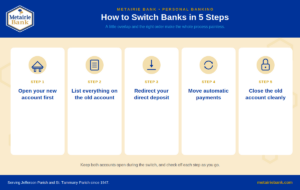
Step 1: Open Your New Account First
Don’t close your current account before opening the new one.
Opening the new account first gives you a place to move deposits and payments to while the old account remains available as a backup.

Metairie Bank offers several personal checking options, including Simply Free Checking. Not sure which account is right for you? You can review the Compare Checking Accounts chart to see free and interest-earning options side by side.
Many accounts can be opened online in minutes. Or if you prefer, we have full-service branch locations close to where you live in Metairie, Covington, Mandeville, or elsewhere in the Greater New Orleans area.
A local banker can help you find the right one that fits the way you bank.
Once the new account is open, add enough money to cover the payments you plan to move over right away. Meanwhile, keep the old account funded too. You’ll need both during the transition.
Step 2: Make a List of Everything Connected to the Old Account
Pull up at least two or three months of bank statements. If you have annual or quarterly charges, look back farther so you don’t miss them.
List every recurring transaction, including paychecks, retirement income, utilities, insurance premiums, loan payments, subscriptions, transfers, payment apps, and any company that keeps your debit card or bank information on file.
Small charges are often the easiest to overlook. A subscription that renews once a year may not appear on your most recent statement, so take your time with this step.
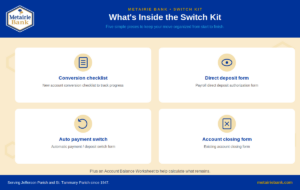
Metairie Bank’s Switch Kit can help organize the process. It includes a New Account Conversion Checklist, Payroll Direct Deposit Authorization Form, Automatic Payment/Deposit Switch Form, Existing Account Closing Form, and Account Balance Worksheet.
Use the checklist and forms in the kit to track what’s moved and what still needs attention.
Metairie Bank’s Switch Kit can help organize the process. It includes a New Account Conversion Checklist, Payroll Direct Deposit Authorization Form, Automatic Payment/Deposit Switch Form, Existing Account Closing Form, and Account Balance Worksheet.
Use the checklist and forms in the kit to track what’s moved and what still needs attention.
Step 3: Redirect Your Direct Deposit
Your direct deposit should be one of the first items you move.
Give your employer or other income source the routing and account numbers for your new Metairie Bank account. The Payroll Direct Deposit Authorization Form in the Switch Kit can help.
Processing times vary, so submit the change as soon as the new account is ready.
Then watch both accounts. Don’t assume the change is complete until you see a full deposit arrive in the new one. Keeping the old account open and funded gives you breathing room in case one more payment is sent there.
If you receive Social Security benefits by direct deposit, you may be able to update your banking information through your personal my Social Security account. You can also contact the Social Security Administration at 1-800-772-1213 for help.
The same principle applies to pensions, retirement distributions, and other regular income. Contact each payer directly and confirm what it requires.
Step 4: Move Automatic Payments and Linked Services
Once your deposits have moved, update the payments connected to your old account.
Work through your list and change the banking or debit card information for utilities, insurance providers, lenders, subscription services, and other recurring bills. The Automatic Payment/Deposit Switch Form inside the switch kit can help with companies that need written authorization.
Some services can be updated online in minutes. Others may require a form, phone call or full billing cycle before the change takes effect.
Check less obvious connections, too. Is your old debit card saved with an online retailer? Is a payment app connected to the account? Do you have recurring transfers? Is Zelle or another person-to-person service linked to the old bank?
Update each service and make a note when it’s done.
As a rule of thumb, we recommend keeping the previous account open for about two months. During that overlap, check both accounts regularly and keep enough money in the old one to cover anything that hasn’t moved yet. This can help you avoid an overdraft, returned payment, or late fee.
Step 5: Close the Old Account Cleanly
Once all deposits and payments are going through the new account, review the old one again.
Make sure outstanding checks have cleared, pending transactions are complete, automatic payments have stopped, direct deposits are arriving in the new account, and no fees are still being charged.
Use the Account Balance Worksheet in the switch kit to calculate what remains. Then provide specific written instructions to close the account. The Existing Account Closing Form can help with that step.
Ask for written confirmation that the account has been closed. If money remains, confirm how the balance will be returned.
Don’t assume the account is closed simply because the balance reaches zero. An open account could still be charged a fee or receive a forgotten transaction.
If you have unused checks or an old debit card from the financial institution you’re leaving, bring them to a Metairie Bank branch. We will buy back eligible checks and debit cards for up to $10 and destroy them for you.
Make the Switch With Metairie Bank
Switching banks is easier when you take it one step at a time.
Metairie Bank’s Switch Kit gives you the forms and checklist you need to stay organized, and our bankers are available to answer any additional questions you might have.
Since 1947, Metairie Bank has served customers across Greater New Orleans and the Northshore, and we’re eager to show you why we’re known as the Bank of Personal Service.
If you’re ready to switch, we’re ready to help. Open your Metairie Bank account online in minutes, download the Switch Kit, or stop by a branch and let a local banker guide you through the process.